International Journal of Physiotherapy Research and Clinical Practice
DOI: 10.54839/ijprcp.v5i3.26.8
Year: 2026, Volume: 5, Issue: 3, Pages: 5-10
Original Article
R Bennat 1*, B G Dharaneesh 1, Sri Shankar M2, Manoj Abraham Manoharlal3
1MPT 2nd Year, K.G College of Physiotherapy (Affiliated to The Tamil Nadu Dr MGR Medical University, Chennai), Coimbatore, Tamil Nadu, India
2Professor, K.G College of Physiotherapy (Affiliated to The Tamil Nadu Dr MGR Medical University, Chennai), Coimbatore, Tamil Nadu, India
3Professor/Principal, K.G College of Physiotherapy (Affiliated to The Tamil Nadu Dr MGR Medical University, Chennai), Coimbatore, Tamil Nadu, India
*Corresponding author
R Bennat
Email: [email protected]
Carpal tunnel syndrome is a prevalent entrapment neuropathy among IT professionals, often associated with pain, reduced grip strength, and functional limitations. Scapular stabilization exercises may improve upper limb function by enhancing proximal stability. To investigate the effects of scapular stabilization exercises on symptom severity, pain, and grip strength in IT professionals with CTS. Forty participants with mild to moderate CTS were randomly allocated into two groups: a control group received conventional physiotherapy, and an experimental group received conventional therapy combined with SSE. Interventions were administered for 4 weeks. Outcome measures included the symptom severity by Boston Carpal Tunnel Questionnaire, pain by Numeric Pain Rating Scale, and grip strength by hand-held dynamometer. Statistical analysis was performed using paired and independent t-tests, with significance set at p < 0.05. Both groups showed significant within-group improvement (p < 0.05). The experimental group demonstrated greater improvement in BCTQ (1.8 ± 0.3 vs. 2.2 ± 0.3) and grip strength (30.8 ± 4.6 kg vs. 27.5 ± 4.3 kg). Pain scores were comparable between groups (2.3 ± 0.7 vs. 2.4 ± 0.7; p > 0.05). SSE combined with conventional therapy is more effective in improving symptom severity and grip strength in CTS, with no additional benefit in pain reduction.
Keywords: Carpal tunnel syndrome, IT professionals, Scapular stabilization exercises, Hand-held dynamometer, Boston carpal tunnel questionnaire, NPRS
Carpal tunnel syndrome (CTS) is caused by compression of the median nerve within the carpal tunnel, leading to symptoms such as tingling, numbness, burning sensations, reduced grip strength and limited hand movements[1]. Risk factors are categorized into constitutional (obesity, smoking), hormonal (diabetes, hypothyroidism, hormonal therapies), and musculoskeletal factors, particularly in individuals with repetitive hand use[2]. Musculoskeletal factors are commonly observed among individuals working in office-based environments. From a pathophysiological perspective, the carpal tunnel is a narrow and inflexible space, and any condition that increases pressure within this area, such as repetitive hand use, prolonged wrist positions away from neutral alignment, or thickening of the synovial lining, can trigger symptoms related to carpal tunnel syndrome[3].
It has an estimated prevalence of around 10% and is responsible for nearly 90% of all nerve compression disorders[1]. The prevalence was reported to be 21.5%, with a greater occurrence observed among females (33.3%) compared to males (17.4%). The largest number of CTS cases was identified in individuals who worked for approximately eight hours per day. Although it is frequently seen in office workers who regularly use computers, the number of working hours alone does not appear to be a significant risk factor. Instead, implementing proper ergonomic practices and conducting early screening are considered to be more effective strategies than simply reducing computer usage time to minimize disability in workplace environments[3].
Rehabilitation for CTS often involves various physical therapy techniques such as laser therapy, manual therapy combined with neurodynamic methods, and functional massage. In addition, several complementary approaches, including acupuncture, yoga, and various forms of massage therapy, are used as alternative treatments[4, 5].
Scapular stabilization exercises are designed to activate muscles such as the serratus anterior, trapezius, and rhomboids to improve shoulder blade alignment, control, and strength. These are often combined with stretching of tight muscles like the pectoralis minor and upper trapezius. Overall, they help correct abnormal scapular movement, enhance posture, and improve muscle function[6]. The upper limb functions as an integrated kinetic chain, wherein proximal segments influence the mechanics and loading of distal joints. Consequently, scapular instability may disrupt normal force transmission and neuromuscular control, leading to increased mechanical stress on the elbow and wrist. A 2025 systematic review found that adding scapular exercises to conventional therapy improved function and grip strength and reduced pain in upper-limb conditions[7]. Similarly, in lateral epicondylitis and medial epicondylitis, combining scapular and shoulder strengthening with local treatment showed better outcomes than elbow-focused therapy alone[7, 8]. In occupational settings, particularly among individuals who frequently use computers and laptops, these altered biomechanics, combined with sustained postures like forward head posture and rounded shoulder, may increase the risk of developing carpal tunnel syndrome.
Therefore, this study aims to evaluate the effects of scapular stabilisation exercises on symptom severity, pain and grip strength among IT professionals diagnosed with carpal tunnel syndrome.
Participants: 59 subjects (34 men, 25 women) were enrolled from the Department of Physiotherapy at the KG Physiotherapy and Rehabilitation Centre, Saravanampatti, Coimbatore, Tamil Nadu. A total of 40 participants were recruited based on specific inclusion and exclusion criteria. Sample collection was done by the survey method from nearby IT companies in Coimbatore. The lottery method of randomisation was used. Inclusion criteria included IT professionals aged 30–45 years diagnosed with mild to moderate carpal tunnel syndrome (CTS) based on clinical stages classification[9], with a Numeric Pain Rating Scale (NPRS) score ranging from 3 to 7. Participants were required to have a minimum of 6 hours of daily computer use, symptom duration exceeding 3 months, and positive clinical tests, including Phalen’s and Tinel’s signs. Both male and female participants with a forward shoulder angle of less than 52° were included[10]. Exclusion criteria comprised individuals with a history of fractures, trauma, or previous surgical interventions affecting the upper limb, presence of cervical radiculopathy or other neurological disorders, rheumatoid arthritis, severe psychiatric conditions influencing pain perception, pregnancy, and bilateral carpal tunnel syndrome.
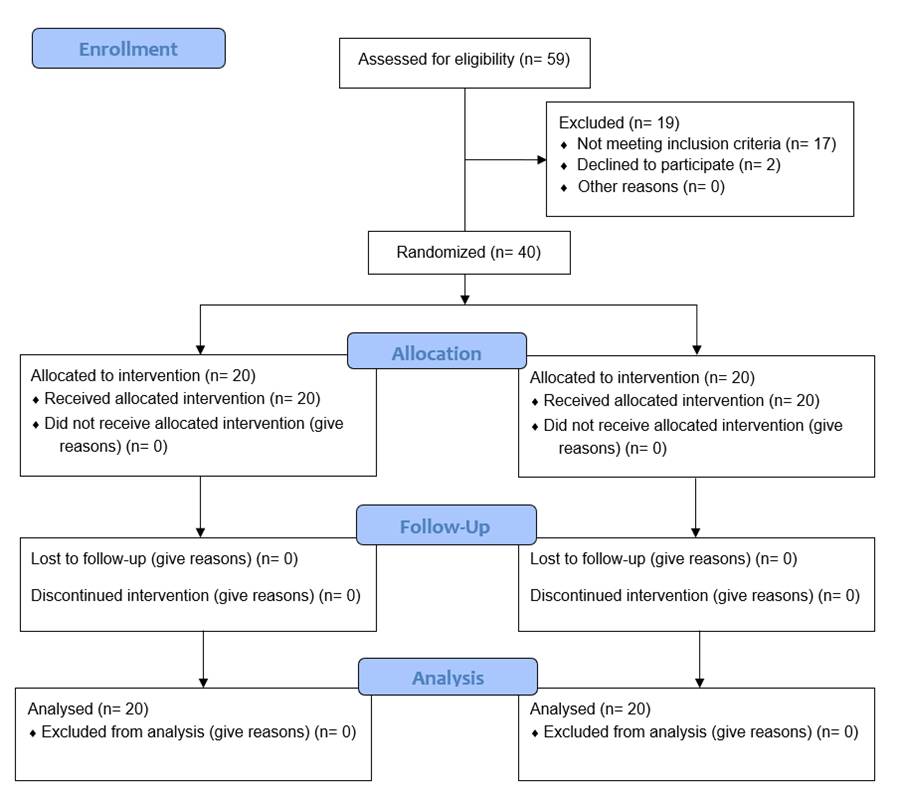
All eligible participants provided informed consent before enrolment in the study. They were then randomly assigned to two groups, with 20 participants in each. Group A (control group) received conventional physiotherapy, while Group B (experimental group) received conventional physiotherapy combined with scapular stabilisation exercises. Both groups underwent their respective interventions for a duration of 4 weeks. Outcome measures were recorded at baseline (Week 0) and after completion of the intervention (Week 4). All participants completed the study. The CONSORT flow chart was mentioned in [Fig. 1].
This group received pulsed therapeutic ultrasound targeting the median nerve. Ultrasound was delivered at 1 MHz frequency and 1.0 W/cm² intensity with a 25% duty cycle (1:4) to promote non-thermal mechanical effects[11]. Median nerve neural mobilization (gliding, tensioner) was administered by a trained therapist[6]. Tendon and nerve gliding exercises were advised as a home program for the participant[12]. Wrist splinting was also advised. Wrist flexor and extensor stretching was advised as 15-second stretches performed for 5 repetitions, repeated 5 times daily, 7 days a week, for 4 weeks. Strengthening exercises include Ball squeezing, spreading the fingers against a rubber band, and Wrist Curls[13].
Participants were educated to maintain a neutral wrist position and proper keyboard height while typing, and to adopt healthy work habits such as taking regular breaks and minimizing repetitive wrist movements.
In addition to conventional therapy, this group received scapular stabilisation exercises. This program consisted of three components performed for 4 weeks. ‘W’ wall slides were executed with the back in full contact with the wall, where the arms were positioned in a “W” formation and slid upward while maintaining continuous wall contact, followed by a return to the starting position. Shoulder retraction exercises were performed with elbows flexed at 90° and arms close to the body, involving squeezing the scapulae together, holding for 5 seconds, and then relaxing, ensuring no elevation of the shoulders. Backward shoulder rolls involve circular movements of the shoulders in an upward, backward, and downward direction while keeping the arms adjacent to the trunk. All exercises were performed twice daily; ‘W’ wall slides and shoulder retraction were completed in 3 sets of 15 repetitions, while backward shoulder rolls were performed for 3 sets of 2 minutes[14]. The outcome measures were assessed before and after the intervention period. The primary outcome measure was the Boston Carpal Tunnel Questionnaire (BCTQ) – Symptom Severity Scale. Secondary outcome measures included the Numeric Pain Rating Scale (NPRS) to assess pain intensity and grip strength, measured with a hand dynamometer to evaluate functional hand performance.
Statistical analysis was performed using SPSS version 26.0. Data were expressed as mean and standard deviation. The normality of data distribution was assessed using the Shapiro–Wilk test. Within-group comparisons between pre- and post-intervention values were analysed using the paired t-test for normally distributed data, while between-group comparisons were performed using the independent t-test. The level of statistical significance was set at p < 0.05 with a 95% confidence interval.
Statistical analysis of the baseline data revealed no significant difference between Group A and Group B. Baseline demographic, work-related, and clinical characteristics including age, gender, body mass index (BMI), daily computer use, dominant hand, affected hand, duration of symptoms, Boston Carpal Tunnel Questionnaire (BCTQ) score, and Numeric Pain Rating Scale (NPRS) showed no statistically significant differences between the groups (p > 0.05), indicating that both groups were comparable before the intervention. A summary of baseline data was presented in [Table. 1].
|
Variable |
Group A |
Group B |
p-value |
|---|---|---|---|
|
Age (years) |
27.9 ± 4.0 |
29.4 ± 3.9 |
0.72 |
|
Gender (M/F) |
10/10 |
12/8 |
0.69 |
|
BMI (kg/m²) |
25.2 ± 3.2 |
25.5 ± 3.2 |
0.77 |
|
Computer use |
7.0 ± 0.8 |
6.9 ± 0.9 |
0.81 |
|
Dominant hand |
20/0 |
20/0 |
— |
|
Affected hand (R/L) |
12/8 |
13/7 |
0.75 |
|
Duration (months) |
6.0 ± 1.0 |
5.9 ± 1.0 |
0.84 |
|
BCTQ score |
2.9 ± 0.2 |
2.9 ± 0.2 |
0.91 |
|
NPRS (pain) |
5.7 ± 0.8 |
5.6 ± 0.8 |
0.88 |
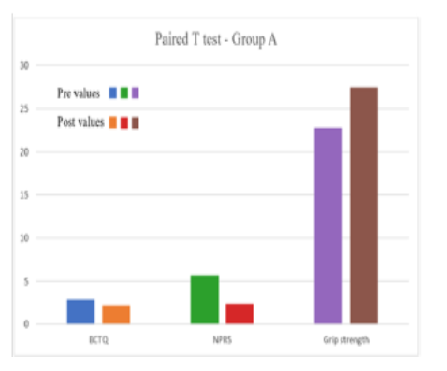
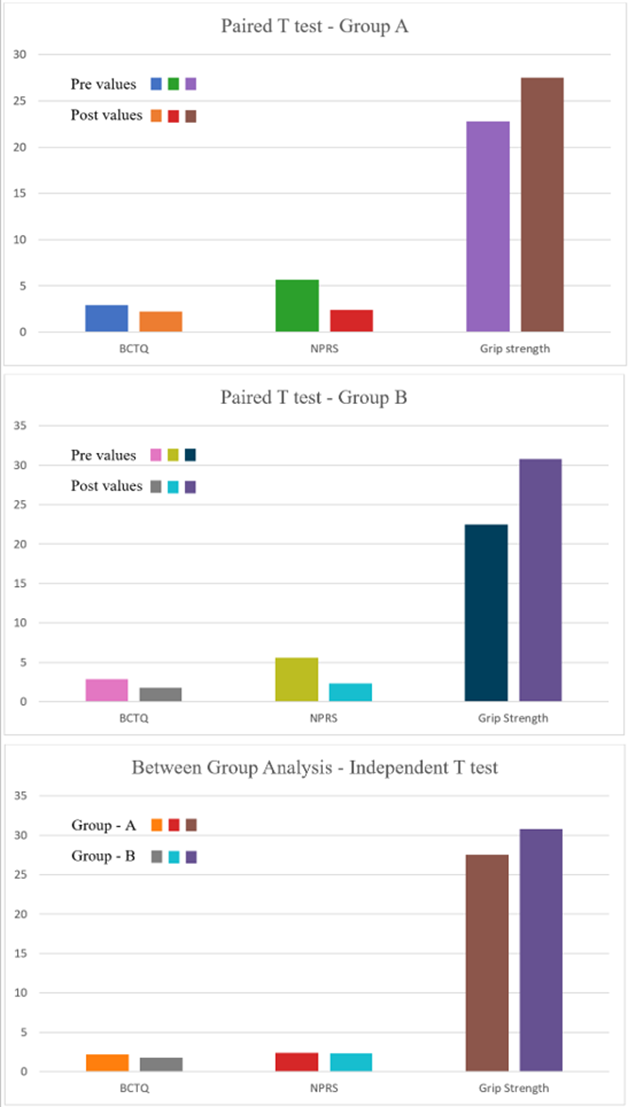
In the control group (Group A, n = 20), statistically significant improvements were observed in all outcome measures following the intervention. The mean BCTQ score decreased from 2.9 ± 0.2 to 2.2 ± 0.3, NPRS scores reduced from 5.7 ± 0.8 to 2.4 ± 0.7, and grip strength increased from 22.8 ± 4.0 kg to 27.5 ± 4.3 kg. All changes were highly significant (p < 0.05).
|
Outcome |
Pre |
Post |
p-value |
|---|---|---|---|
|
BCTQ |
2.9 ± 0.2 |
2.2 ± 0.3 |
<0.05 |
|
NPRS |
5.7 ± 0.8 |
2.4 ± 0.7 |
<0.05 |
|
Grip strength |
22.8 ± 4.0 |
27.5 ± 4.3 |
<0.05 |
In the experimental group (Group B, n = 20), significant improvements were also noted across all parameters. The mean BCTQ score decreased from 2.9 ± 0.2 to 1.8 ± 0.3, NPRS scores reduced from 5.6 ± 0.8 to 2.3 ± 0.7, and grip strength improved from 22.5 ± 4.2 kg to 30.8 ± 4.6 kg. These improvements were statistically significant (p < 0.05).
|
Outcome |
Pre |
Post |
p-value |
|---|---|---|---|
|
BCTQ |
2.9 ± 0.2 |
1.8 ± 0.3 |
<0.05 |
|
NPRS |
5.6 ± 0.8 |
2.3 ± 0.7 |
<0.05 |
|
Grip strength |
22.5 ± 4.2 |
30.8 ± 4.6 |
<0.05 |
Comparison of post-intervention outcomes between the two groups revealed that the experimental group (Group B) demonstrated significantly greater improvement than the control group in BCTQ scores (1.8 ± 0.3 vs 2.2 ± 0.3, p = 0.002) and grip strength (30.8 ± 4.6 kg vs 27.5 ± 4.3 kg, p = 0.01). However, there was no statistically significant difference in NPRS scores between the groups (2.3 ± 0.7 vs 2.4 ± 0.7, p = 0.74), indicating comparable pain reduction in both groups.
|
Outcome |
Group A Post |
Group B Post |
p-value |
|---|---|---|---|
|
BCTQ |
2.2 ± 0.3 |
1.8 ± 0.3 |
0.002* |
|
NPRS |
2.4 ± 0.7 |
2.3 ± 0.7 |
0.74 |
|
Grip strength |
27.5 ± 4.3 |
30.8 ± 4.6 |
0.01* |
The findings of this study demonstrated a significant reduction in carpal tunnel syndrome-related symptoms and pain and improvements in grip strength following the intervention, indicating the clinical relevance of incorporating proximal stabilization into CTS rehabilitation.
The reduction in symptoms observed in this study can be attributed to improved scapular alignment and postural correction. IT professionals are highly prone to sustained forward head posture and rounded shoulders, which increase mechanical stress along the upper limb neural pathway and contribute to median nerve irritation. A recent scoping review on occupational CTS highlighted that repetitive tasks, poor ergonomics, and sustained postures are key contributors to symptom development and persistence. By enhancing activation of stabilising muscles, SSE improves scapular positioning and reduces abnormal loading patterns, thereby decreasing nociceptive input and neural tension[15].
Grip strength showed notable improvement post-intervention, which may be linked to reduced pain and improved neuromuscular control. According to the concept of proximal stability for distal mobility, enhanced scapular stability provides a stable base for effective hand function. The observed improvements align with the findings of Fernández-de-las-Peñas C et al. (2017), who reported that interventions targeting both proximal and distal components can significantly enhance functional outcomes in CTS patients[16]. The study by Park et al. (2025) found that combining scapular stabilisation exercises with thoracic stretching significantly improved grip strength in college students. It suggests that scapular stabilisation enhances upper limb muscle function—thereby contributing to better grip strength[17]. One cross-sectional study concluded that there is a significant positive correlation observed between scapular muscle strength and grip strength[18].
Proximal strengthening reliably improves strength, biomechanics, and function, but distal pain may lag or persist because of remaining local mechanical issues, insufficient strength change, and central/psychosocial contributors. Combining proximal and distal interventions and addressing pain mechanisms directly is often needed when pain does not follow functional gains[19].
Furthermore, the results of this study support the concept of regional interdependence, where impairments in one region of the body can contribute to dysfunction in another. In the context of CTS, proximal factors such as scapular dyskinesis and poor posture may contribute to distal symptoms. Addressing these proximal impairments through SSE can therefore play a crucial role in reducing symptom severity and improving functional performance. This is in agreement with Wainner RS (2007), who highlighted the importance of considering the entire kinetic chain in musculoskeletal rehabilitation[20].
Despite these positive findings, it is important to recognise that scapular stabilisation exercises alone may not be sufficient as a standalone treatment for CTS. A multimodal approach, including nerve gliding, ergonomic correction, and wrist-specific interventions, is recommended for optimal outcomes[13].
The study was limited by a small sample size, short intervention duration, which restricts generalizability and weakens causal conclusions. Additionally, reliance on clinical and functional outcomes without electrophysiological confirmation, along with the focus solely on IT professionals, further narrows its applicability. Future research should involve larger, more diverse populations with long-term follow-up. Incorporating objective assessments such as nerve conduction studies and electromyography, along with evaluating functional performance outcomes, is recommended. Moreover, exploring the combined effects of scapular stabilisation exercises with nerve gliding and ergonomic interventions may provide more comprehensive insights into effective management strategies.
The present study demonstrates that the addition of scapular stabilisation exercises to conventional physiotherapy is more effective in improving symptom severity and grip strength among IT professionals with carpal tunnel syndrome. Although both groups showed significant reductions in pain, no significant difference was observed between the groups for pain outcomes. These findings support the role of proximal stabilisation and postural correction in enhancing functional recovery in CTS. Therefore, incorporating scapular stabilisation exercises as part of a comprehensive rehabilitation program may provide superior clinical benefits in this population.
1. Subiyanto ATK, Rahayu UB, Asha K. Management Physiotherapy for Carpal Tunnel Syndrome: A Case Report. Ahmar Metastasis Health Journal. 2023; 3 (2). Available from: https://doi.org/10.53770/amhj.v3i2.203
2. Gebrye T, Jeans E, Yeowell G, Mbada C, Fatoye F. Global and Regional Prevalence of Carpal Tunnel Syndrome: A Meta‐Analysis Based on a Systematic Review. Musculoskeletal Care. 2024; 22 (4). Available from: https://doi.org/10.1002/msc.70024
3. Shaukat F, Alam MM, Bhatti ZM, Nawal A, Niazi AK, Irfan H, et al. Frequency of Carpal Tunnel Syndrome in Office Workers Using Computers with Respect to Working Hours. Journal of Health, Wellness, and Community Research. 2025; Available from: https://doi.org/10.61919/p0jcgh96
4. Bobowik PŻ. Effectiveness of physiotherapy in carpal tunnel syndrome (CTS). Advances in Rehabilitation. 2019; 33 (2). Available from: https://doi.org/10.5114/areh.2019.85023
5. Jiménez-del-Barrio S, Cadellans-Arróniz A, Ceballos-Laita L, Estébanez-de-Miguel E, López-de-Celis C, Bueno-Gracia E, et al. The effectiveness of manual therapy on pain, physical function, and nerve conduction studies in carpal tunnel syndrome patients: a systematic review and meta-analysis. International Orthopaedics. 2022; 46 (2). Available from: https://doi.org/10.1007/s00264-021-05272-2
6. Nitayarak H, Charntaraviroj P. Effects of scapular stabilization exercises on posture and muscle imbalances in women with upper crossed syndrome: A randomized controlled trial. Journal of Back and Musculoskeletal Rehabilitation. 2021; 34 (6). Available from: https://doi.org/10.3233/bmr-200088
7. Gutiérrez-Espinoza H, Araya-Quintanilla F, Estrella-Flores E, Cuyul-Vásquez I, Hagert E, Struyf F. Effectiveness of a scapular exercise program on functional outcomes in patients with hand, wrist or elbow disorders: A comprehensive systematic review with meta-analysis. Journal of Hand Therapy. 2025; 38 (3). Available from: https://doi.org/10.1016/j.jht.2024.07.006
8. Goldfarb J, Grimes JK, Bauer P. Utilizing Scapular Stabilization Exercises in a Patient With Medial Epicondylalgia: A Case Report. JOSPT Cases. 2021; 1 (1). Available from: https://doi.org/10.2519/josptcases.2021.9980
9. Alfonso C, Jann S, Massa R, Torreggiani A. Diagnosis, treatment and follow-up of the carpal tunnel syndrome: a review. Neurological Sciences. 2010; 31 (3). Available from: https://doi.org/10.1007/s10072-009-0213-9
10. Khosravi Z, Mohammad Ali Nasab Firouzjah E, Firouzjah MH. Comparison of balance and proprioception of the shoulder joint in girls with and without upper cross syndrome. BMC Musculoskeletal Disorders. 2024; 25 (1). Available from: https://doi.org/10.1186/s12891-024-07552-5
11. Nitayarak H, Charntaraviroj P. Ultrasound treatment for treating the carpal tunnel syndrome: randomised “sham” controlled trial. Europe PMC. 2026; Available from: https://europepmc.org/article/pmc/28476
12. Abdolrazaghi HA, Khansari M, Mirshahi M, Ahmadi Pishkuhi M. Effectiveness of Tendon and Nerve Gliding Exercises in the Treatment of Patients With Mild Idiopathic Carpal Tunnel Syndrome: A Randomized Controlled Trial. HAND. 2023; 18 (2). Available from: https://doi.org/10.1177/15589447211006857
13. Graham B, Peljovich AE, Afra R, Cho MS, Gray R, Stephenson J, et al. The american academy of orthopaedic surgeons evidence-based clinical practice guideline on: management of carpal tunnel syndrome. Journal of Bone and Joint Surgery. 2016; 98 (20). Available from: https://doi.org/10.2106/jbjs.16.00719
14. Gunaydin OE, Ertekin E, Gunaydin G. Four weeks of exercise regimen for sedentary workers with rounded shoulder posture: a randomized controlled study. Sao Paulo Medical Journal. 2023; 141 (3). Available from: https://doi.org/10.1590/1516-3180.2022.0257.r1.06072022
15. Rotaru-Zavaleanu AD, Lungulescu CV, Bunescu MG, Vasile RC, Gheorman V, Gresita A, et al. Occupational Carpal Tunnel Syndrome: a scoping review of causes, mechanisms, diagnosis, and intervention strategies. Frontiers in Public Health. 2024; 12 Available from: https://doi.org/10.3389/fpubh.2024.1407302
16. Fernández-de-las-Peñas C, Cleland J, Palacios-Ceña M, Fuensalida-Novo S, Pareja JA, Alonso-Blanco C. The Effectiveness of Manual Therapy Versus Surgery on Self-reported Function, Cervical Range of Motion, and Pinch Grip Force in Carpal Tunnel Syndrome: A Randomized Clinical Trial. Journal of Orthopaedic & Sports Physical Therapy. 2017; 47 (3). Available from: https://doi.org/10.2519/jospt.2017.7090
17. Park KT, Kim SM, Nam TG. Effects of Thoracic Stretching Combined with Scapular Stabilization Exercises on Grip Strength and Muscle Activation in College Students. The Journal of Korean Academy of Physical Therapy Science. 2025; 32 (4). Available from: https://doi.org/10.26862/jkpts.2025.12.32.4.111
18. Pawar M, Ekbote V. Correlation Between Grip Strength and Scapular Muscles Strength Among Goldsmith Workers in Pune: A Correlational Study. International Journal of Health Sciences and Research. 2024; 14 (7). Available from: https://doi.org/10.52403/ijhsr.20240710
19. Earl JE, Hoch AZ. A Proximal Strengthening Program Improves Pain, Function, and Biomechanics in Women With Patellofemoral Pain Syndrome. The American Journal of Sports Medicine. 2011; 39 (1). Available from: https://doi.org/10.1177/0363546510379967
20. Wainner RS, Whitman JM, Cleland JA, Flynn TW. Regional Interdependence: A Musculoskeletal Examination Model Whose Time Has Come. Journal of Orthopaedic & Sports Physical Therapy. 2007; 37 (11). Available from: https://doi.org/10.2519/jospt.2007.0110
@ 2026 Published by Krupanidhi College of Physiotherapy. This is an open-access article under the CC BY license (https://creativecommons.org/licenses/by/4.0/)
Subscribe now for latest articles and news.