International Journal of Physiotherapy Research and Clinical Practice
DOI: 10.54839/ijprcp.v5i3.25.42
Year: 2026, Volume: 5, Issue: 3, Pages: 21-24
Case Report
Alagappan Thiyagarajan1*, S Aravind2, S Jeyakumar3
1Lecturer, Faculty of Health Sciences, Nursing and Education, Mahsa University, Selangor, Malaysia
2Assistant professor, Saveetha College of Physiotherapy, Saveetha Institute of Technical Sciences, Thaldalam, Chennai, TamilNadu, India
3Professor and Research Supervisor, Garden City University, Bangalore, Karnataka, India
*Corresponding Author
Alagappan Thiyagarajan
Email: [email protected]
Anterior cruciate ligament (ACL) reconstruction with concomitant medial and lateral meniscus repair requires a structured rehabilitation protocol for optimal outcomes. However, when patients self-manage rehabilitation without clinical supervision, recovery can be delayed. This case presents a 28-year-old female patient exhibiting overconfidence and non-compliance, influenced by online self-research, leading to suboptimal progress during the first four weeks post-surgery. The patient was referred to First Step Physiotherapy Clinic for post-operative rehabilitation. A comprehensive reassessment was conducted using objective tools including the KOOS scale and single-leg balance test, alongside a clinician-rated psychological adherence scale. Rehabilitation was restructured with emphasis on closed kinetic chain exercises, proprioceptive training, and gradual weight-bearing progression. Initial assessment revealed inadequate neuromuscular activation, poor proprioceptive control, and psychological resistance to clinical advice. Over six weeks of guided therapy, the patient showed measurable improvements in balance, function, and adherence. KOOS scores improved from 38/100 to 65/100, and single-leg stance time increased from 6 to 18 seconds, reflecting better control and engagement. This case highlights the risks of unsupervised rehabilitation and underscores the importance of early referral and professional guidance. Psychological readiness and patient attitude are critical factors influencing rehab success. Tailored communication, structured outcome tracking, and behavioral tools can enhance compliance in patients prone to self-directed overconfidence.
Keywords: ACL reconstruction, Rehabilitation adherence, Physiotherapy, Patient behavior
Anterior cruciate ligament (ACL) reconstruction combined with medial and lateral meniscus repair requires a structured, progressive rehabilitation approach to ensure optimal functional recovery and safe return to play. Rehabilitation success is not only dependent on surgical technique but also heavily influenced by patient compliance, mindset, and willingness to follow evidence-based physiotherapy protocols. This case report presents a 28-year-old Indian female patient referred for physiotherapy four weeks post-operatively following ACL reconstruction with both medial and lateral meniscal repair. Upon presentation, the patient reported having performed self-guided rehabilitation, mostly limited to open-chain exercises sourced from the physiotherapist. Despite the complexity of her surgical procedure, she had not received structured professional physiotherapy during the initial post-operative period[1, 2].
A key challenge in managing this case was the patient's overconfidence and self-perceived expertise, often referencing information from online sources to question clinical decisions. She was resistant to recommendations such as delayed weight-bearing, feather-touch loading strategies, and the transition to closed-chain and proprioceptive exercises, all of which are vital in protecting healing meniscal structures and graft integrity. Additionally, the patient expressed a strong desire to evaluate the physiotherapist’s clinical approach and infrastructure before fully committing, indicating a lack of trust in professional judgment despite being referred by her orthopedic surgeon. This dynamic created barriers to establishing therapeutic rapport and necessitated a communication strategy that balanced empathy, education, and clinical authority. This case highlights the growing influence of internet-driven self-diagnosis and treatment, which can compromise recovery if not corrected through professional guidance[3]. It underscores the importance of therapist-patient collaboration, adherence to post-operative timelines, and the need for physiotherapists to navigate complex patient behaviors while ensuring safe, outcome-driven rehabilitation.
This case was managed at First Step Physiotherapy Clinic, Chennai, a private orthopedic and sports rehabilitation center equipped with facilities for post-surgical care, neuromuscular training, and psychological screening of athletes. The patient was enrolled for a structured post-operative rehabilitation program following an orthopedic referral, four weeks after undergoing ACL reconstruction with medial and lateral meniscal repair.
A comprehensive initial assessment was conducted to determine the functional status, pain levels, and psychological readiness for rehabilitation progression. Two patient-focused outcome measures were used to track physical recovery. The Knee Injury and Osteoarthritis Outcome Score (KOOS) was selected to evaluate subjective symptoms, daily living function, sports-related performance, and knee-specific quality of life. This tool is validated for post-ACL reconstruction monitoring and was administered at baseline, mid-rehabilitation (week 8), and before return-to-sport decisions (week 12). Additionally, the Single-Leg Balance Test (SLBT) was used to assess proprioceptive control and neuromuscular readiness, a key component in functional rehabilitation following meniscus repair[4, 5].
To address the behavioral and psychological concerns noted in the patient-specifically, non-compliance, overconfidence, and potential distrust toward professional care-a clinician-administered psychological tool, the Rehabilitation Adherence Questionnaire (RAQ), was utilized. This tool evaluates patient attitudes, beliefs, and motivation toward rehabilitation protocols and healthcare providers. It helped objectively measure the patient’s psychological engagement, compliance risk, and readiness to follow structured guidance.
The rehabilitation protocol was individualized, focusing on progressive loading, joint protection, and neuromuscular control. Given the meniscal repair, partial weight-bearing was delayed until the sixth postoperative week, beginning with feather-touch support and gradually progressing to full weight-bearing by week 8. Closed-chain kinetic exercises, core stability training, and proprioceptive drills were introduced under supervision. The patient attended three sessions per week, and adherence to the home program was encouraged via a daily exercise log. Informed written consent was obtained from the patient for participation and publication. The case was documented in accordance with the CARE guidelines and handled following ethical principles of clinical physiotherapy care.
At the time of referral, the patient’s progress raised concerns due to the limited effectiveness of self-managed rehabilitation over the initial four weeks. There was minimal neuromuscular activation, poor proprioceptive control, and no structured weight-bearing progression. Additionally, her overconfidence, resistance to clinical input, and reliance on self-researched information posed psychological barriers to adherence. These shortcomings necessitated a cautious re-evaluation and redesign of her rehab plan, with objective outcome measures guiding recovery and managing expectations[6-8].
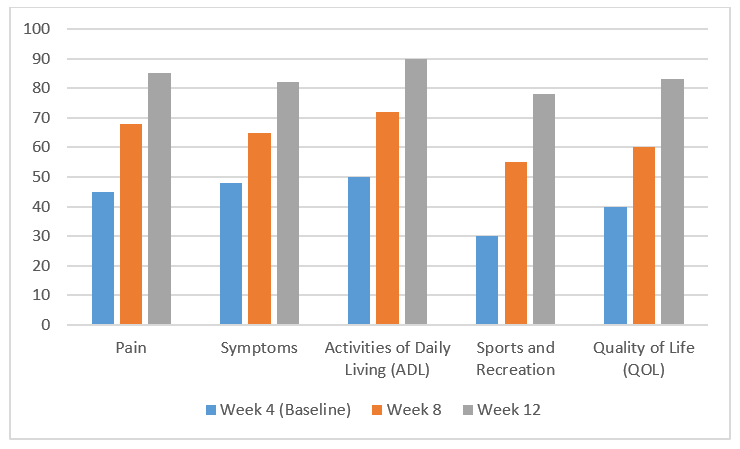
Functional outcome progression (KOOS)
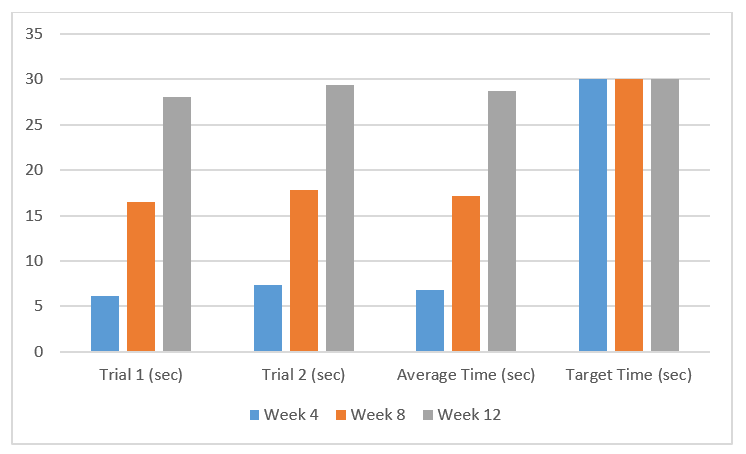
Proprioception test results (Single-Leg Balance Test - SLBT)
Psychological readiness (Rehabilitation Adherence Questionnaire - RAQ)
| Domain | Week 4 (Baseline) | Week 8 | Week 12 |
|---|---|---|---|
| Pain | 45 | 68 | 85 |
| Symptoms | 48 | 65 | 82 |
| Activities of Daily Living (ADL) | 50 | 72 | 90 |
| Sports and Recreation | 30 | 55 | 78 |
| Quality of Life (QOL) | 40 | 60 | 83 |
| Overall KOOS (%) | 42.6 | 64 | 83.6 |
Interpretation: Progressive improvement was observed in all domains, reflecting successful clinical rehabilitation and patient compliance after mid-phase correction.
|
Assessment Point |
Trial 1 (sec) |
Trial 2 (sec) |
Average Time (sec) |
Target Time (sec) |
|---|---|---|---|---|
|
Week 4 |
6.2 |
7.4 |
6.8 |
30 |
|
Week 8 |
16.5 |
17.8 |
17.2 |
30 |
|
Week 12 |
28.1 |
29.4 |
28.7 |
30 |
Interpretation: Significant improvements in proprioceptive control and balance were seen from week 4 to week 12, nearing normative targets.
|
Category |
Week 4 (Initial) |
Week 8 |
Week 12 |
|---|---|---|---|
|
Motivation to Attend Sessions |
2/5 |
4/5 |
5/5 |
|
Trust in Therapist/Program |
1/5 |
3/5 |
4/5 |
|
Exercise Completion at Home |
2/5 |
4/5 |
5/5 |
|
Willingness to Follow Instructions |
2/5 |
3/5 |
5/5 |
|
Total Score (out of 20) |
7 |
14 |
19 |
Interpretation: Initial resistance and low motivation improved significantly through personalized education, therapist rapport, and structured progression.
This case highlights the complex interplay between post-surgical physiotherapy, patient psychology, and the evolving challenges posed by self-guided health information. Rehabilitation following ACL reconstruction with concomitant medial and lateral meniscus repair requires strict adherence to loading protocols, neuromuscular training, and psychological readiness for return-to-play. However, in this patient, early self-management without professional input, guided by online sources, resulted in suboptimal early-phase rehabilitation and unrealistic expectations about recovery timelines[9-11].
Despite the initial non-compliance and skepticism, structured intervention using objective tools like KOOS and SLBT enabled clear communication of progress and the importance of following a staged protocol. Improvements across these measures showed that even in cases of delayed or misdirected early rehab, outcomes can be corrected through patient-centered care, clinical reasoning, and therapeutic rapport.
An important aspect of this case was the patient’s psychological barrier—manifested through distrust and a desire to self-evaluate the clinician. The use of the Rehabilitation Adherence Questionnaire (RAQ) proved vital in tracking behavioral shifts and tailoring educational strategies. As scores improved across weeks, the patient demonstrated greater engagement and compliance, which corresponded to her functional gains[12].
This case also draws attention to a growing concern in contemporary practice—the “internet-informed” patient who may undervalue clinical expertise. While informed patients are encouraged, the challenge lies in guiding them to differentiate between general knowledge and condition-specific evidence-based protocols. The physiotherapist’s role thus extends beyond technical execution to include educator, motivator, and communicator. In summary, this case underscores that managing post-ACL rehabilitation goes beyond biomechanics. Successful outcomes depend equally on psychological insight, behavioral management, and structured reassessment. Early resistance can be overcome with empathy, education, and objective tracking tools that guide both clinician and patient toward a collaborative, outcome-driven path to recovery[13, 14].
This case underscores the importance of a multidisciplinary and evidence-based approach to post-operative rehabilitation following complex knee surgeries like ACL reconstruction with medial and lateral meniscus repair. Managing an overconfident, internet-informed patient presented unique challenges, particularly due to early unsupervised rehabilitation and psychological resistance to professional input. Despite the initial challenges, structured intervention helped reorient the patient toward safer and more effective recovery. This case highlights the delicate balance between patient autonomy and professional guidance in rehabilitation. Future research should explore strategies to improve patient compliance in tech-savvy, self-directed individuals post-surgery.
Early Referral to Physiotherapy: Timely referral post-surgery is critical to avoid misdirected self-rehabilitation; however, this case was referred only after 4 weeks, delaying structured progress.
Use of Objective Outcome Measures: Tools like single-leg balance and KOOS scores guided recovery effectively; yet, their interpretation is limited in patients with inconsistent compliance.
Integration of Psychological Assessment: Incorporating simple clinician-rated tools improved patient insight and engagement; still, the absence of formal psychological testing may overlook deeper issues.
Enhanced Patient Education and Rapport: Tailored education helped correct misinformation and improve trust; however, patient skepticism due to over-reliance on online sources remained a persistent barrier[15].
Limitations:
The case involved only a single patient; findings cannot be generalized.
Psychological assessment was limited to clinician-administered tools and may benefit from formal psychometric testing.
Return-to-sport outcomes were not followed long-term.
Patient bias and pre-existing attitudes may have influenced adherence despite structured efforts.
1. Adams D, Logerstedt DS, Hunter-Giordano A, Axe MJ, Snyder-Mackler L. Current Concepts for Anterior Cruciate Ligament Reconstruction: A Criterion-Based Rehabilitation Progression. Journal of Orthopaedic & Sports Physical Therapy. 2012; 42 (7). Available from: https://doi.org/10.2519/jospt.2012.3871
2. Ardern CL, Taylor NF, Feller JA, Webster KE. A systematic review of the psychological factors associated with returning to sport following injury. British Journal of Sports Medicine. 2013; 47 (17). Available from: https://doi.org/10.1136/bjsports-2012-091203
3. Ardern CL, Österberg A, Sonesson S, Gauffin H, Webster KE, Kvist J. Satisfaction with knee function after primary ACL reconstruction is associated with self-efficacy, quality of life, and returning to pre-injury sports level. British Journal of Sports Medicine. 2016; 50 (15). Available from: https://doi.org/10.1136/bjsports-2015-095992
4. Bandura A. (1997). Self-efficacy: The exercise of control. Freeman.
5. Barber-Westin SD, Noyes FR. Factors Used to Determine Return to Unrestricted Sports Activities After Anterior Cruciate Ligament Reconstruction. Arthroscopy. 2011; 27 (12). Available from: https://doi.org/10.1016/j.arthro.2011.09.009
6. Bohannon RW, Larkin PA. Lower Extremity Weight Bearing Under Various Standing Conditions in Independently Ambulatory Patients with Hemiparesis. Physical Therapy. 1985; 65 (9). Available from: https://doi.org/10.1093/ptj/65.9.1323
7. Brewer BW. (2009). Injury prevention and rehabilitation. In Eklund, R. C., & Tenenbaum, G. (Eds.), Encyclopedia of Sports and Exercise Psychology (pp. 402–406). Sage.
8. Brewer BW, Cornelius AE, Van Raalte JL, Tennen H, Armeli S, Pensgaard AM. Adherence to sport injury rehabilitation: A daily log analysis. Journal of Sport Rehabilitation. 2003; 12 (2). Available from: https://doi.org/10.1123/jsr.12.2.157
9. Chmielewski TL, George SZ, Tillman SM, Moser MW, Lentz TA, Indelicato PA, et al. Low strength is related to increased pain and reduced function in patients with anterior cruciate ligament reconstruction. Physical Therapy. 2011; 91 (9). Available from: https://doi.org/10.2522/ptj.20100350
10. Czuppon S, Racette BA, Klein SE, Harris-Hayes M. Variables associated with return to sport following anterior cruciate ligament reconstruction: a systematic review. British Journal of Sports Medicine. 2014; 48 (5). Available from: https://doi.org/10.1136/bjsports-2012-091786
11. Davies GJ, McCarty E, Provencher M, Manske RC. ACL return to sport guidelines: Part I. Journal of Orthopaedic & Sports Physical Therapy. 2017; 47 (11). Available from: https://doi.org/10.2519/jospt.2017.7285
12. Duda JL, Treasure DC. (2010). Motivational processes and the facilitation of quality engagement in sport. In J. M. Williams (Ed.), Applied sport psychology: Personal growth to peak performance (6th ed., pp. 57–81). McGraw-Hill
13. Ebert JR, Edwards PK, Yi L, Joss B. Strength and functional symmetry is associated with return to sport following ACL reconstruction. Knee Surgery, Sports Traumatology, Arthroscopy. 2020; 28 (4). Available from: https://doi.org/10.1007/s00167-019-05748-6
14. Ekdahl M, Wang JH, Ronga M, Fu FH. Anatomic double-bundle anterior cruciate ligament reconstruction: A literature review. Knee Surgery, Sports Traumatology, Arthroscopy. 2008; 16 (7). Available from: https://doi.org/10.1007/s00167-008-0535-1
15. Eitzen I, Moksnes H, Snyder-Mackler L, Risberg MA. A Progressive 5-Week Exercise Therapy Program Leads to Significant Improvement in Knee Function Early After Anterior Cruciate Ligament Injury. Journal of Orthopaedic & Sports Physical Therapy. 2010; 40 (11). Available from: https://doi.org/10.2519/jospt.2010.3345
@ 2026 Published by Krupanidhi College of Physiotherapy. This is an open-access article under the CC BY license (https://creativecommons.org/licenses/by/4.0/)
Subscribe now for latest articles and news.